
How Finnish cities turned digital collaboration into standard infrastructure practice
Finland has been ahead of much of Europe on machine control and model-based construction for years. The more telling development now is not that individual projects have gone digital, but that whole public construction portfolios run that way — designers, contractors and city supervisors working from one shared model, with quality data flowing back in real time and oversight possible from any desk.
That shift is clearest in two cities. The City of Espoo, Finland’s second largest, runs an annual infrastructure budget of roughly €100 million and uses Infrakit across essentially all of its projects. The City of Jyväskylä has put much of its construction and maintenance work on the same footing and pushed the idea further upstream than most by writing model-based requirements directly into how it buys projects. Neither got there overnight, and neither treats it as remarkable anymore. Together they show how digital collaboration in Finnish infrastructure has moved from pilot to routine.
This is their story, told mainly by the people who run the work.
The change that matters: quality data in real time
Ask an infrastructure owner what genuinely changed, and the answer rarely starts with software. It starts with timing.
“Quantity data is obtained from projects in more real time than before, which makes project documentation easier,” says Jani Ahokas, construction manager and head of the infrastructure department at the City of Espoo. “Project management has also improved, because actual data can be monitored in real time in relation to what was planned.”
That sounds modest until you picture what it replaced. On a traditional multi-year scheme, quality verification was often a scramble at the very end — reviewing two years of work in a single week before handover and hoping the documentation held together. Model-based delivery inverts that sequence. Contractors produce quality data continuously, the city validates it as it arrives, and problems surface while they are still cheap to correct.
“Machine control and model-based construction have diminished traditional measurement. However, the role of the measurement manager has grown from a previous traditional role toward a more comprehensive project quality management role.” — Jani Ahokas, City of Espoo
That second point is easy to miss and worth dwelling on. Digitalization did not remove the surveyor; it changed the job. Less manual staking, more responsibility for the data that proves the work was built as designed. It is a useful corrective to the assumption that model-based methods simply automate roles away.
Espoo: every project, one platform
Espoo’s adoption was gradual rather than sudden. The city’s own construction department has used Infrakit for over a decade; it entered design-build contracts from around 2017; and portfolio-wide use across contractor projects took hold after pilot projects in 2021 and 2022, becoming the default from 2023.
Today the department employs around 100 construction professionals, working on civil and municipal engineering and bridge works. In practice that means roughly 30 to 40 projects a year running through Infrakit, around 200 active desktop and mobile users, and a further 100 machine users; across all roles — contractors, designers, city staff and machine operators — monthly active users have recently reached over 300. Contract values span from a few hundred thousand euros to just under €10 million, covering street construction and rehabilitation, water and sewer networks, bridges and pile slabs. Alongside the large tendered contracts, the city’s own crews use the platform on smaller in-house works.
The model is demanding by design: on tendered design-build contracts, the winning contractor is required to work model-based, run machine control and 3D models, and use Infrakit. Designers deliver design models — for street layouts, water and sewer systems, and IFC bridge models — the contractor derives machine-control models from them, and all quality documentation returns to one place visible to both sides.
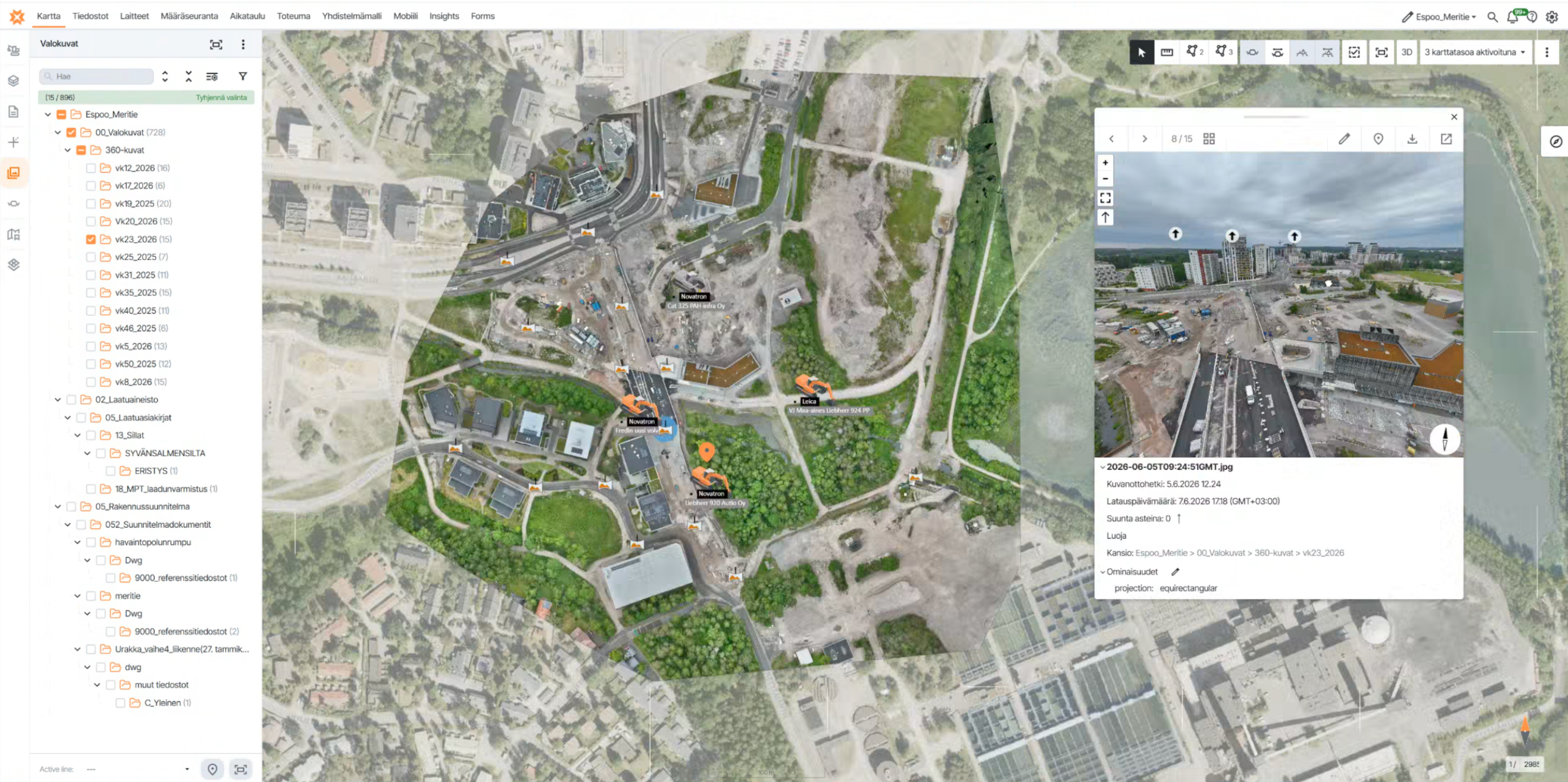
That shared visibility is the heart of it. As Manu Marttinen, an Infrakit specialist with 25 years in infrastructure who has worked alongside Espoo for around four years, puts it, the arrangement gives each project a super user from the contractor and a super user from the city, so that “there are no secrets between these players.” For a public client supervising tens of millions of euros of work it did not build itself, a single, continuously updated source of truth is not a convenience but a necessity.
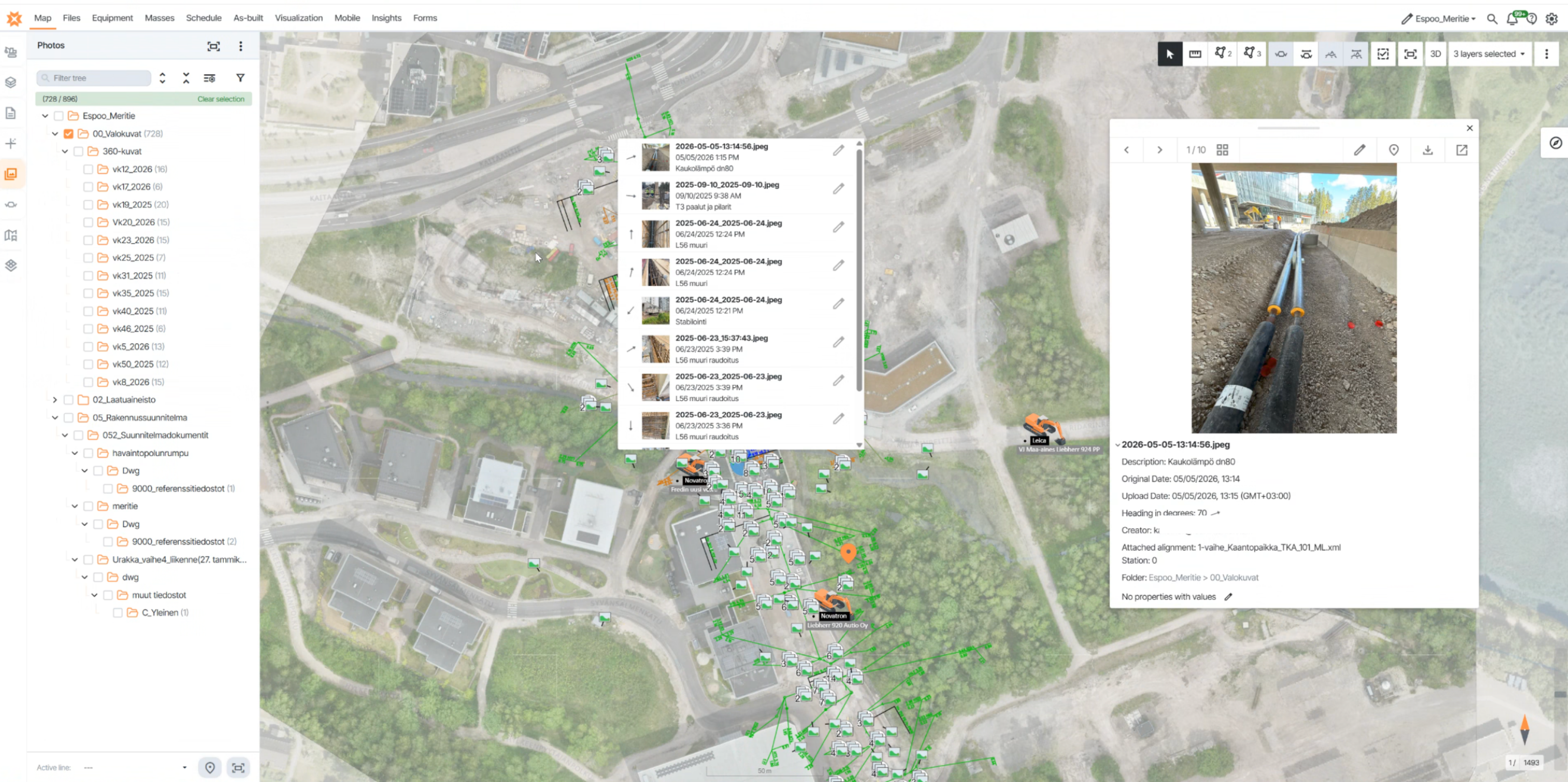
A favored reference is the Meritie Bridge, a shore-side scheme built on a tight, sea-adjacent site that combined piling work close to the water with conventional layers and complex concrete structures. The constraints were exactly the kind that punishes poor coordination. The contractor managed the work through Infrakit while the city supervised and collected all quality data, and the map-based view let both sides see at a glance where each element had to be built and against which requirements.
Jyväskylä: setting the rules before the work begins
If Espoo shows what portfolio-wide adoption looks like, Jyväskylä shows where the real leverage sits — in the requirements an owner defines before a single contractor is hired.
The city runs roughly 20 percent of its work through its own construction unit and 80 percent through external contractors, and like Espoo it puts virtually all of it through Infrakit, across both construction and maintenance. It introduced the platform in 2016 and has spent the years since deliberately developing its own model-based data and quality requirements and building them into the tendering phase — in effect, setting the rules for how contractors must construct, so the city can confirm it receives what it is paying for. It paired that with sustained investment in training its own people. Two figures are widely credited as the drivers: development manager Teemu Liimatainen and BIM coordinator Matti Hannuksela.
Olli Planting, the Infrakit specialist who works with the city, notes how undramatic mature adoption looks. “When it’s in daily use, the mystery and the coolness go away, because it becomes business as usual,” he says. “But true efficiency is there.” For Hannuksela, that efficiency is fundamental to how the city works. “Model-based construction has significantly improved the way we work,” he says. “Through Infrakit, site managers, survey equipment, construction machines and project personnel all have access to plans and digital models. As-built measurements collected on site can also be easily reviewed within Infrakit, so project data is managed as comprehensively as possible within a single platform.”
Liimatainen, who introduced Infrakit to the city in 2016 and now follows it from a greater distance, takes a pragmatic view of the benefits — and is refreshingly candid about what the city has and has not quantified. “Infrakit has brought clear improvements to quality control and site accuracy,” he says. “It has increased operational efficiency through better management of machine control. We have not conducted precise calculations on cost savings or emission reductions, but it is evident that the management of construction phases has become much more efficient.”
The city’s flagship is the Tourujoki River renovation, a program worth around €7 million to return a long-engineered urban river toward its natural state. For a city of its size it ranks among the most significant projects of the next five years — not only in infrastructure, but across everything Jyväskylä is building. It is a fitting example of where these methods are now applied: not back-office utility works, but visible, strategic investment.
A national pattern, not two exceptions
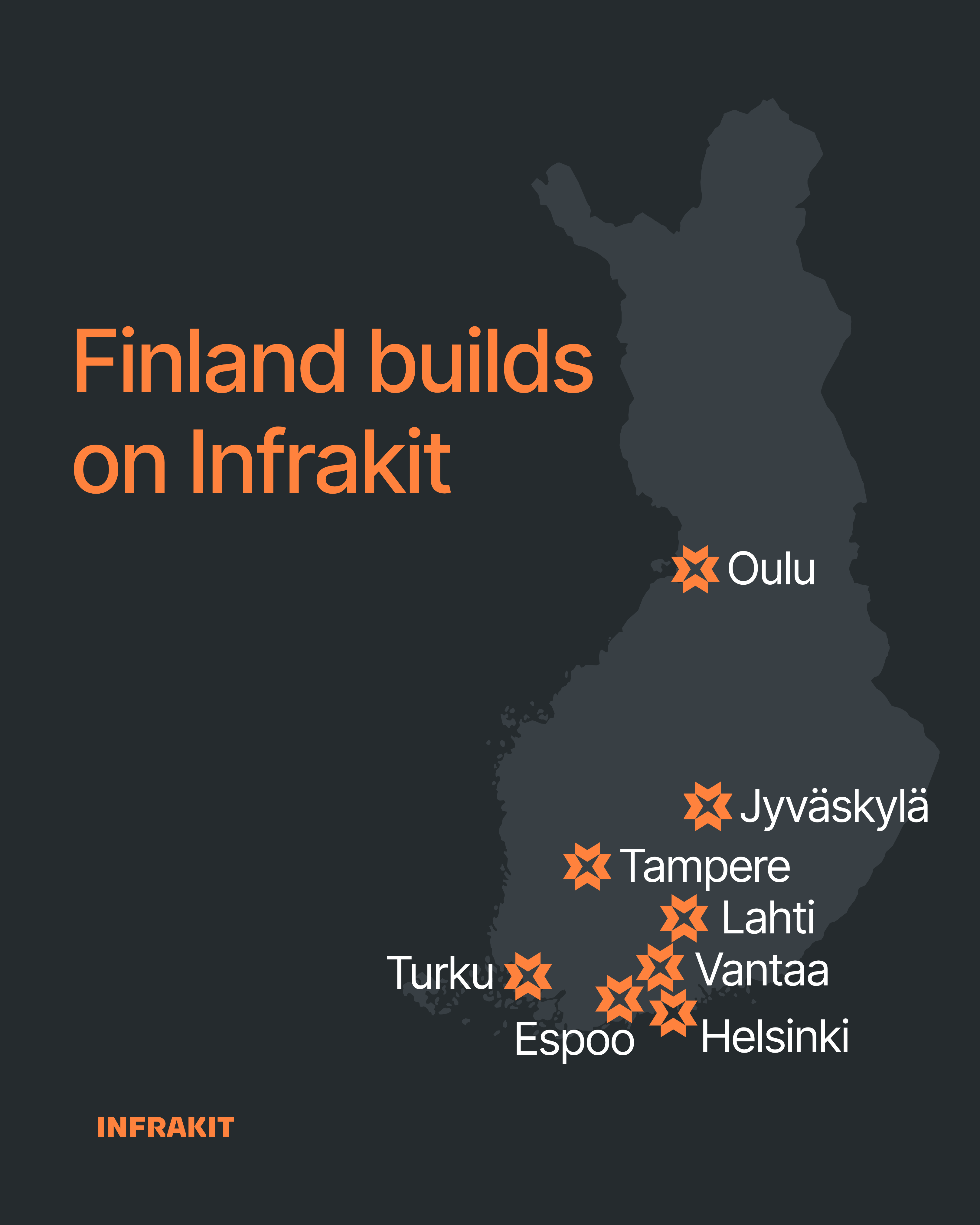
Espoo and Jyväskylä are the clearest cases, but they are not outliers. Turku runs most or all of its projects on the platform; Lahti uses it across most of its work; Oulu was part of the same early cohort that developed these methods together. Tampere’s construction department uses it heavily, as does Helsinki’s own construction arm, STARA — a long-standing and capable user. Vantaa rounds out a group of municipalities that, between them, account for a substantial share of Finland’s infrastructure delivery, and several cities now apply the same model-based approach in the design phase as well.
One reason the practice spread is that these cities did not develop in isolation. Working with the same service team at the same time, they compared notes and carried lessons between organizations — what worked in Turku informing Espoo, and the reverse. That peer learning, more than any single feature, is what turned a handful of advanced adopters into a national norm.
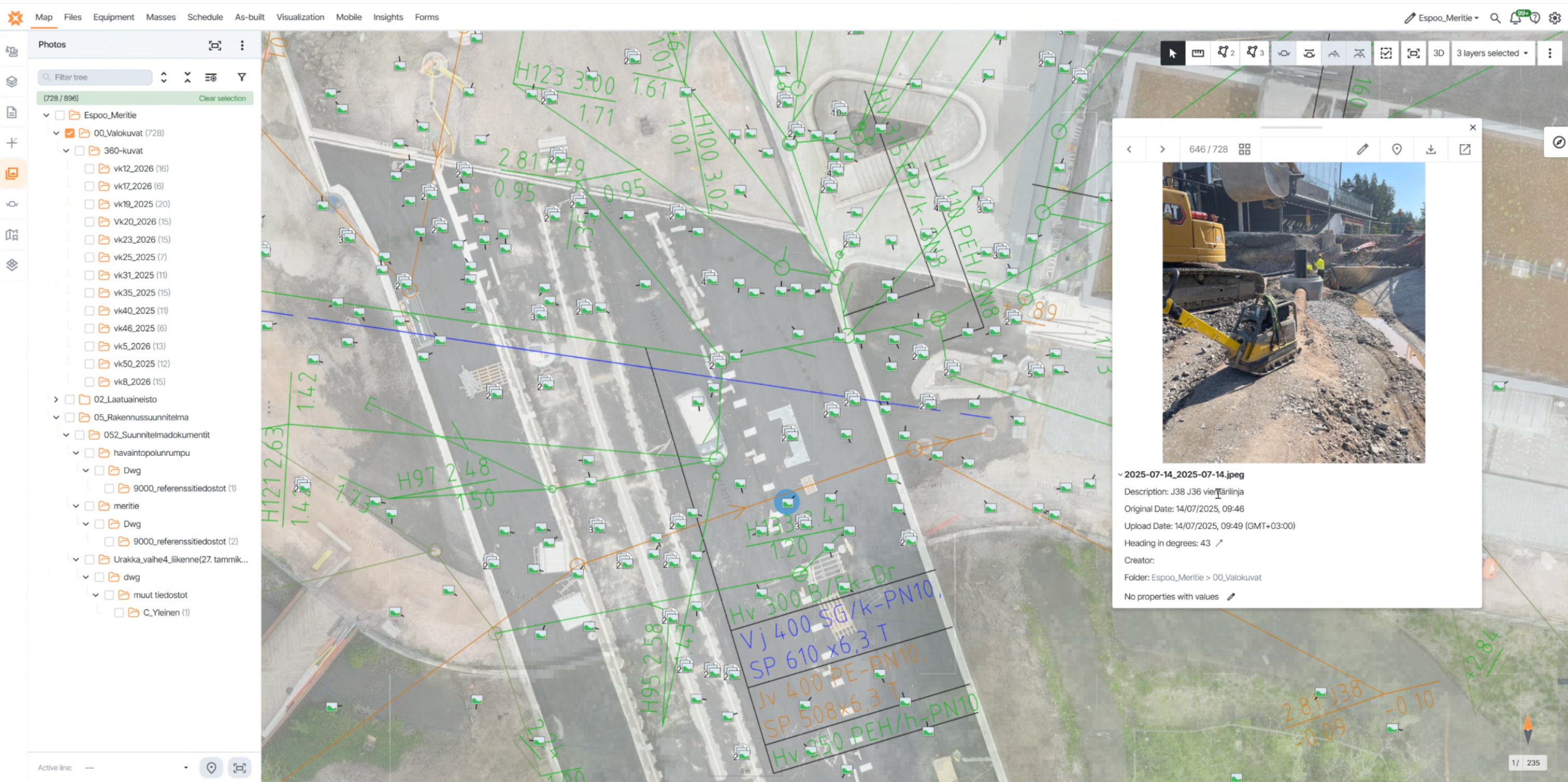
What does the day-to-day actually look like? Across these cities the common workflows are consistent: viewing site photos and quality documentation, using that information to approve installments when a contractor invoices for completed work, monitoring progress against plan, and assembling the quality record for handover. Each matters for a concrete reason. Photo and quality documentation give supervisors evidence without a site visit. Tying payment approvals to documented progress keeps commercial decisions defensible. And because the handover package builds itself as the project proceeds, the end-of-project reckoning that once consumed weeks largely disappears. The same shared record means a manager can follow a project from anywhere, not only from the site.
It is the transparency that practitioners tend to single out. Asked what matters most about the platform, Liimatainen lists manageability, efficiency and quality; Hannuksela adds two more. “I would also add transparency and clarity,” he says. “Everyone can see what is happening on site, and when everything operates on a single platform, the entire workflow becomes much clearer.”
One platform at the center of a wider toolkit
None of this requires a single tool to do everything. Infrakit sits at the center of a broader digital environment and connects to specialist applications around it. In Jyväskylä, a direct integration carries field photos and reporting captured in Buildie back into Infrakit, where the project as a whole can be viewed. On Espoo’s City Rail project, Infrakit is used alongside other digital tools, each serving a different purpose. The principle the cities work to is straightforward: combine the tools that suit a given task, with Infrakit as the shared collaboration platform where execution and quality data come together. Owners are not forced to choose one and abandon the rest.
People and processes, not software alone
The cities that succeeded share a trait that has little to do with technology. Their advantage was organizational: flexible development units able to change how they work, leaders willing to drive the effort, and a readiness to define structured, model-based requirements rather than simply buying a license. In Espoo, an earlier department head, Hannu Lehtikankare, committed the city to the model-based path before Jani Ahokas took it forward; in Jyväskylä, Liimatainen and Hannuksela played the same driving role. Buying software and buying training is not the same as reshaping an organization’s processes — and it is the process work, the hardest part to purchase off the shelf, that separated the leaders from the rest.
That work was not done alone. In Jyväskylä, the city describes the collaboration with Infrakit’s expert team and support as seamless and consistently available. In Espoo’s case, the support was substantial during development — on the order of 40 to 50 hours a month early on, settling to roughly 10 to 15 hours a month as the city took ownership. Public owners managing portfolios at this scale have generally found an annual professional-services investment of around €100,000 worthwhile against a €100 million construction program; set in that proportion, the case largely makes itself. The point is not the spend but what it buys: not just a tool, but the requirements, processes and quality framework that make the tool deliver.
It is also why experienced owners tend to describe their adoption in terms of budget and coverage rather than user counts. A figure such as monthly active users mixes contractors, designers, city staff and machine operators, and says little on its own. That a roughly €100 million portfolio runs, in its entirety, on a shared model-based platform says a great deal — and it is the measure these organizations themselves find most telling.
The road ahead: from construction to the full lifecycle
The technical frontier now is the full infrastructure lifecycle — design, construction, maintenance and asset management. Today the strength is firmly in the construction phase; the ambition is to carry high-quality as-built data forward into maintenance and long-term asset management, where systems still work very differently from construction tools.
Jyväskylä frames its own next steps in exactly these terms. “We are continuing to develop collaboration starting from the design phase and to make better use of project data,” says Liimatainen. “In particular, asset management and maintenance represent the next major steps for us.” Hannuksela’s ambition is to run the entire design process through Infrakit, so that every stakeholder can review plans already during the design stage, working from comprehensive baseline data.
The wider industry is moving the same way. Finland’s Transport Infrastructure Agency (FTIA), the country’s largest single owner with an annual investment program of roughly €600 million, is developing methods to generate asset-management data from IFC models — a step toward closing the gap between how infrastructure is built and how it is operated over its life. Espoo, meanwhile, is looking at the next step within the construction phase itself: using AI to validate that designs are correct before work begins, so errors are caught at the cheapest possible moment.
Adoption across the wider market is real but not automatic — Infrakit currently reaches an estimated 20 percent of Finland’s infrastructure-owner market, which extends well beyond cities to FTIA, private industrial owners, and green-transition projects in wind, solar and hydrogen. The understanding that this is the right direction is widespread; turning that understanding into practice still takes deliberate effort, the kind Espoo and Jyväskylä invested over several years.
What other owners can learn
There is a quiet irony in writing about Finnish infrastructure owners: they are far more comfortable describing their budgets than their achievements. But the pattern they have built is not modest at all. A city defines model-based data and quality requirements and writes them into its tenders. Contractors build to a shared model and prove the quality as they go. Designer, contractor, supervisor and owner work from the same picture, in real time, with nothing hidden. The handover assembles itself, and the data has somewhere to live afterward.
For municipalities and infrastructure owners elsewhere — including in Central Europe, where interest in data and infrastructure management is rising as machine control matures — Finland offers a working answer rather than a theory. And the advice from those who have done it is refreshingly plain. Asked what he would tell another city beginning the journey, Jani Ahokas does not reach for a framework. “Start experimenting,” he says. Show some courage, begin, and let the rest fall into place.
It is hard to argue with the results. Finland did not get here through a single flagship project. It got here by deciding, city by city, to build on common ground.