
Lukas Schrode, Managing Director and Site Manager at Schrode Bau, a civil engineering contractor and member of the MTS Group, explains how Infrakit evolved from a product trial into an indispensable operating system for construction projects ranging from €100,000 to €3 million.
A Company with Digitalization in Its DNA
Anyone visiting the MTS Group quickly realizes that digitalization is not treated as a standalone initiative—it’s simply how the company operates. MTS develops its own attachments, CAD software, and 3D machine control solutions, testing every new development in its own construction operations before bringing it to market. As the Group’s civil engineering division, Schrode Bau serves both as a proving ground and an early adopter.
The company’s core business is municipal civil engineering, including sewer construction, water pipeline installation, broadband infrastructure, road rehabilitation, and public infrastructure development projects. Individual projects typically range from €100,000 to €3 million, with contracts awarded almost exclusively through public tenders—a market where efficiency, reliable documentation, and on-time delivery are not competitive advantages, but fundamental requirements.
Lukas Schrode summarizes the company’s primary objective:
“The worst-case scenario for me is when work on the construction site comes to a standstill because information is missing, communication breaks down, or people are working with incorrect data. Through digitalization, targeted investments, and effective change management, we’ve been able to make our site teams as productive as possible.”
The Starting Point: Digitized, But Not Connected
Schrode Bau was an early adopter of digital technologies. Every machine was equipped with 3D machine control, manual quantity measurements had been eliminated, the entire measurement process had been digitized, and GNSS rover systems were already part of everyday site operations.
Yet beneath this strong digital foundation lay a growing challenge: the company’s data existed in isolated silos.
Photos were taken on smartphones and shared via WhatsApp or USB drives. Site diaries and quality documentation were stored locally on the foremen’s laptops. While file storage had already moved to the cloud, there was no structured access management. Questions such as Who can access which project? or Who modified which file, and when? often remained unanswered.
Lukas Schrode recalls:
“I couldn’t reliably assign files or track them chronologically. And when a solution only works moderately well, people simply won’t use it consistently. One problem inevitably leads to another.”
The real weakness was not the technology itself—it was the underlying workflow.
Whenever a process required someone to take manual action—uploading a photo, filing a document, forwarding quantity measurements, or sharing information—the reliability of the entire process declined. Not because employees lacked commitment, but because priorities constantly shift on an active construction site.
As Schrode explains:
“The moment a process depends on someone manually triggering it, it will never work 100 percent—never. Anyone who works in construction knows this. When things get busy, manual tasks are the first to be skipped. Once that happens, you can no longer trust the data. And as soon as people lose trust in the data, it’s only a matter of time before they stop trusting the entire system.”
From Product Trial to Long-Term Platform
Schrode Bau’s introduction to Infrakit did not begin through a formal procurement process or a sales presentation. Instead, it grew naturally out of MTS’s own product development activities.
While the MTS Group was developing the integration between its machine control solutions and Infrakit, Schrode Bau evaluated the platform under real project conditions—just as it does with every new MTS product before it reaches customers.
Schrode recalls:
“We were so impressed with the platform that we immediately knew we wanted to keep using it in our daily operations.”
What began as a product trial evolved into a permanent solution that, after nearly three years of practical use, has become deeply embedded in the company’s day-to-day operations.
The decision wasn’t driven by one standout feature that outperformed competing software. Rather, Infrakit filled the critical gap that had previously existed: a central platform capable of connecting workflows and data that had previously remained separate.
Schrode puts it succinctly:
“For us, Infrakit was the missing piece of the puzzle.”
Infrakit in Daily Operations: One Platform, One Source of Truth
Today, Infrakit is far more than just another software application at Schrode Bau—it serves as the company’s single source of truth for project data.
There are no parallel folder structures, no local file storage on laptops or tablets. The rule is straightforward:
“At our company, Infrakit is the only place where project data is stored. Whether it’s me as Managing Director, our site managers, or our foremen—we all work exclusively in Infrakit. If I look for a file and it isn’t there, then for us, that file simply doesn’t exist.”
This level of discipline is not about enforcing rigid rules. It stems from a simple realization: only a single, consistently maintained data source creates the trust required for a digital platform to become an integral part of daily operations.
Role-Based Access Instead of Open File Sharing
Everyone—from management to site managers and foremen—works within the same platform, but each user only has access to the information relevant to their role.
Foremen can only view the construction sites they are actively working on. Write permissions can be configured with fine-grained control, while sensitive documents such as change orders or correspondence with the client remain hidden from site personnel without requiring complicated administration.
Version Control Instead of File Chaos
Previously, every plan revision resulted in another file with a date stamp attached. Before long, dozens of versions of the same sewer layout existed, making it difficult to determine which one was current.
Schrode recalls:
“I used to save every updated drawing with a new date stamp. Eventually, I ended up with fifty versions of the same drawing, all at different stages of development.”
Today, each drawing exists as a single version-controlled file within Infrakit. Every revision is automatically tracked, making it immediately clear who made changes and when—even when multiple site managers are working on the same project simultaneously.
Site Diaries and Quality Documentation Directly from the Field
Foremen now complete daily site reports directly in the mobile app using predefined forms created by the site manager.
Once submitted, each report is automatically stored in the correct project folder—eliminating email attachments and manual filing back at the office.
As Schrode explains:
“Previously, the foreman filled everything out in Excel on his laptop, emailed it to me, and I spent another two hours sorting everything into the right folders. With Infrakit, the entire process is handled centrally.”
Real-Time, Georeferenced Photo Documentation
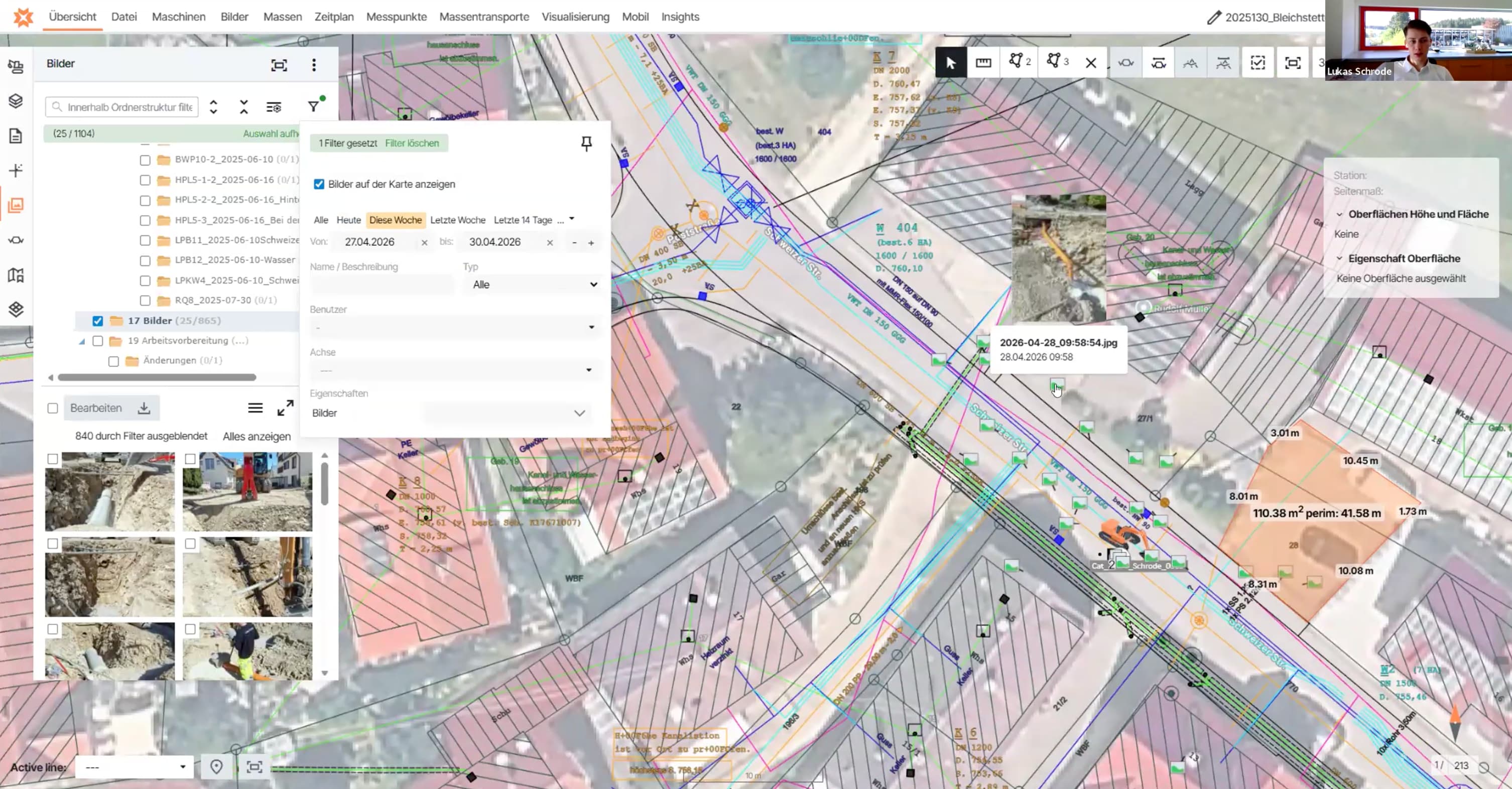
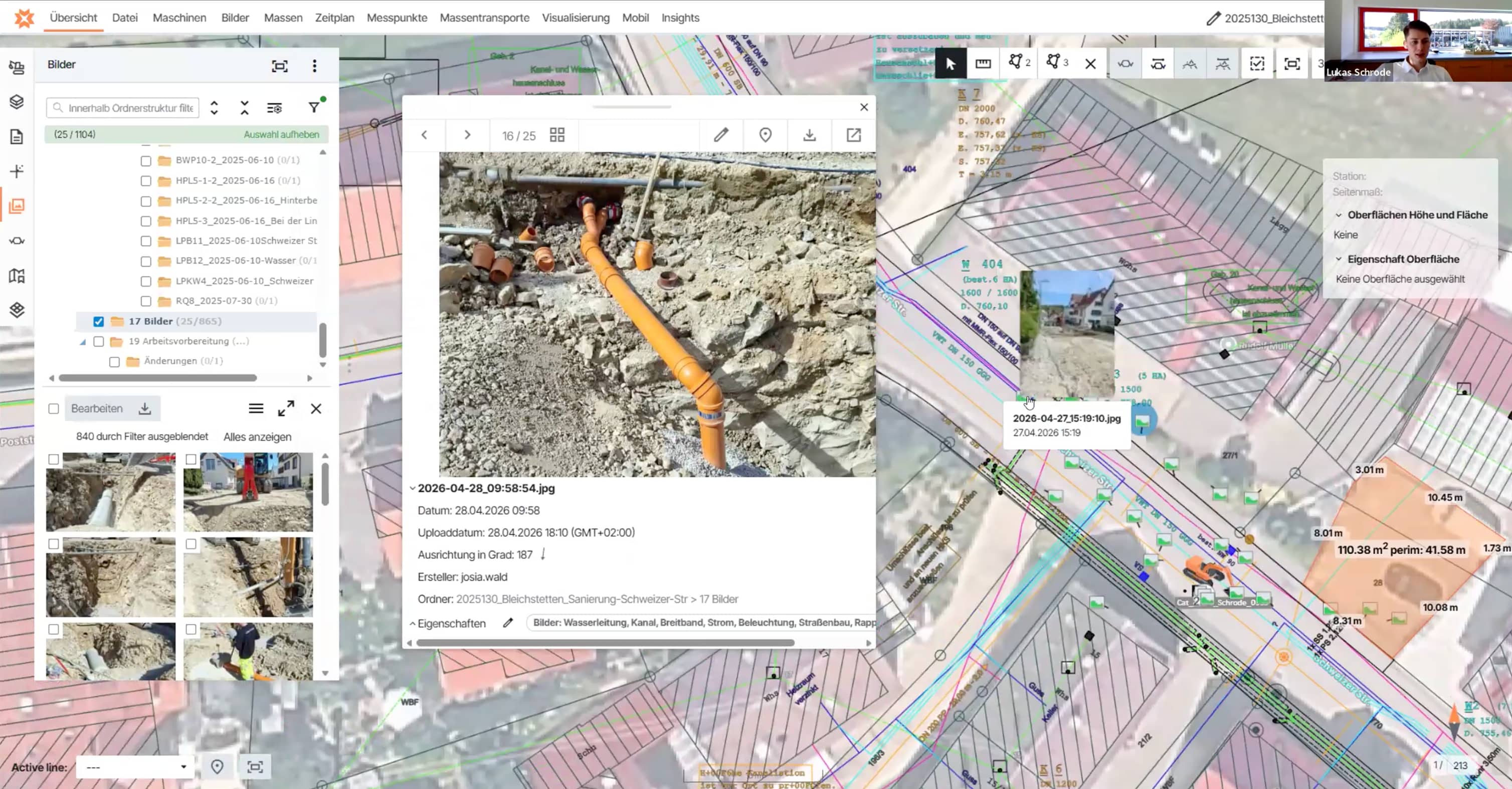
Photos captured on site are automatically uploaded with their geographic location and camera orientation.
Within minutes, they become available across the platform, where they can be filtered by date, foreman, or custom attributes such as Road Construction or Quality Documentation.
This allows site managers to see exactly where work is taking place and what has been documented without leaving the office.
Schrode says:
“As soon as the foreman uploads a photo from the site, it’s immediately available. I don’t have to manually provide information anymore—I know he has direct access to everything he needs.”
Machine Control Managed Through a Single Platform
Machine connectivity is also centralized through Infrakit.
Drawings and digital terrain models can be distributed directly to excavators and GNSS rover systems without transferring files through separate software platforms.
Survey points and machine-generated data flow back into Infrakit, providing site managers with a continuously updated view of construction progress.
“I can centrally manage all of my machine and rover data through Infrakit and distribute it consistently across every device.”
Project Notes Linked Directly to the Map
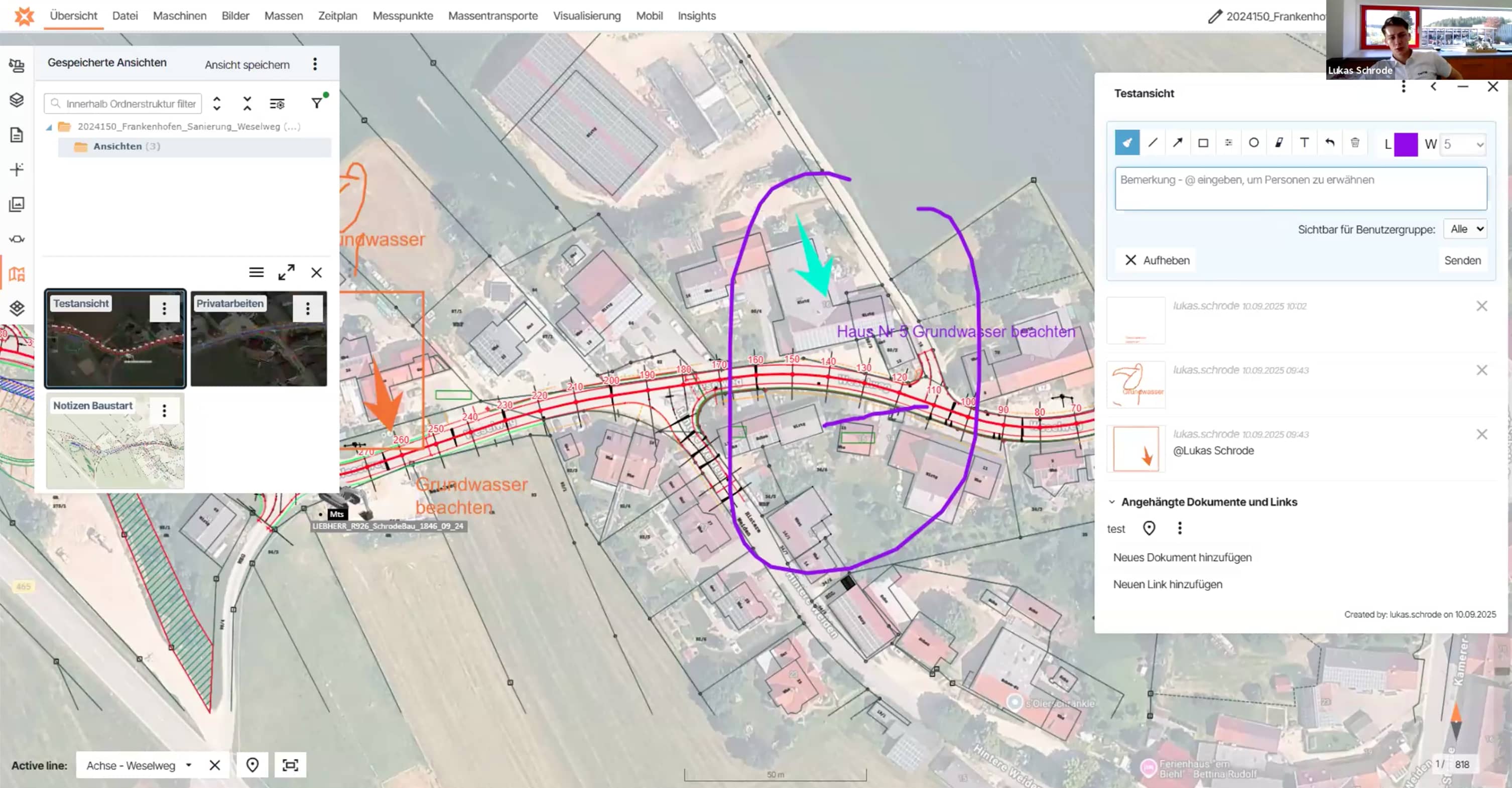
Information gathered from conversations with local residents, details about utility connections, or deviations from the design can be stored as georeferenced notes directly on the project map and assigned to specific team members.
Schrode explains the practical benefit:
“It used to happen all the time—you’d remember discussing something with someone, but six months later you’d forgotten the details. Even worse, someone else never knew about it in the first place. That’s exactly the kind of problem we can eliminate.”
Quantity Verification Without Chasing Project Data
One of the most tangible improvements comes during quantity verification and billing.
Previously, Schrode often had to estimate quantities because photos, reports, and measurement records were incomplete or scattered across different systems.
Today, he simply downloads the GNSS rover data directly from Infrakit, imports it into his quantity takeoff and billing software, and immediately has access to all supporting documentation—including photos, daily site reports, and measurement records.
As he puts it:
“I used to estimate quantities because photos were missing, reports were missing, and measurement records weren’t available. Now I simply download the data for my work package around lunchtime and can immediately evaluate everything in my billing software.”
The State of Digitalization in German Civil Engineering
Lukas Schrode takes a pragmatic view of the industry’s digital transformation. In his region, he sees machine control and GNSS rover systems becoming increasingly common across construction companies. However, he believes the next step—bringing all of that data together in one central platform—is still widely underestimated.
“The problem is that many construction companies have digitized a great deal, but if they can’t bring all that information together, data scattered across different systems is just as useless as having no data at all.”
At the same time, Schrode rejects the argument that poor-quality data from clients or engineering consultancies should be used as an excuse to delay digitalization.
“Preparing project data for a €2 million construction site might cost me around €4,000. What I save afterwards is many times that amount. I’m not going to miss out on digitalization just because I occasionally receive poor-quality data.”
He is equally candid about the platform itself. Infrakit is not a plug-and-play solution.
“It’s not a switch you buy, flip on, and everything just works. You need to train your people, bring them along through the change, and have someone who takes ownership of the implementation. That’s simply part of the process. The advantage of Infrakit is that, fundamentally, it’s easy to use.”
Looking Ahead
For Schrode, Infrakit is not the end goal but part of an ongoing journey of continuous improvement.
Because MTS is also a development partner, practical experience from live construction projects feeds directly into the ongoing development of the platform. The objective remains unchanged: ensuring that the right people have access to the right information at the right time—without manual handovers or disconnected workflows.
Schrode explains his vision:
“I want to bring together as much information as possible in one place. I don’t want to burden my employees with ten different apps—training ten apps, updating ten apps, only for everyone to end up using three of them. With Infrakit, I can consolidate a great deal in one platform. In today’s market, that’s something I consider truly unique.”
And, in true Swabian fashion, he sums it up with characteristic understatement:
“It’s a pretty good piece of software.”
“When work stops on a construction site, it’s usually because information is missing.”
In the video, Lukas Schrode explains how Schrode Bau uses Infrakit to close these information gaps—and why reliable, centralized project data has become a critical success factor in modern civil engineering.