
For utility contractors managing multiple concurrent construction sites, as-built documentation is one of the most persistent and underestimated operational risks. Accurately recording the position of buried pipes, service connections, and underground utilities — and delivering that information to clients at handover — depends on a chain of coordination that is difficult to maintain in practice.
For Midali Frères, a French infrastructure contractor specializing in underground utility construction, the challenge was straightforward: a conventional survey workflow that could not keep up with the pace of site operations. Information lived in photographs, rough sketches, and individual memory. As-built drawings were compiled under time pressure, often from incomplete data. And the surveyor, however skilled, could rarely be on site precisely when needed.
Midali Frères’ adoption of Infrakit did not solve this challenge by adding more survey capacity. It solved it by fundamentally changing who performs the documentation — and when.
The Challenge: Surveying What Is Already Buried
Midali Frères’ previous as-built process was built around a single point of failure: a surveyor who needed to physically attend each site to record installed utilities before the trench was backfilled. In principle, this represents established good practice. In reality, however, the logistics made it nearly impossible to sustain across a portfolio of active sites.
“More often than not, by the time we could get someone out there, everything was already buried.”
The constraint was not a lack of competence. It was a lack of field resources and the practical difficulty of synchronizing survey attendance with the unpredictable pace of installation work.
When the surveyor did arrive, the reconstruction effort would begin: site managers would point out pipe runs from memory, show photographs taken during installation, and annotate rough sketches with as-built information.
The downstream consequences were significant. Compiling that fragmented information at the end of a project was labour-intensive; information loss was a genuine risk, and producing accurate as-built drawings at handover — let alone delivering them to the client on time — was rarely straightforward.
The implications extended beyond internal efficiency: the reliability of the as-built records that Midali Frères delivered at the end of each project was directly at stake.
The Solution: Documentation as a Field Workflow
The structural change that Infrakit introduced was straightforward: it empowered Midali Frères’ site managers to capture and record data themselves, at the point of installation, rather than deferring that task to a specialist resource arriving after the fact.
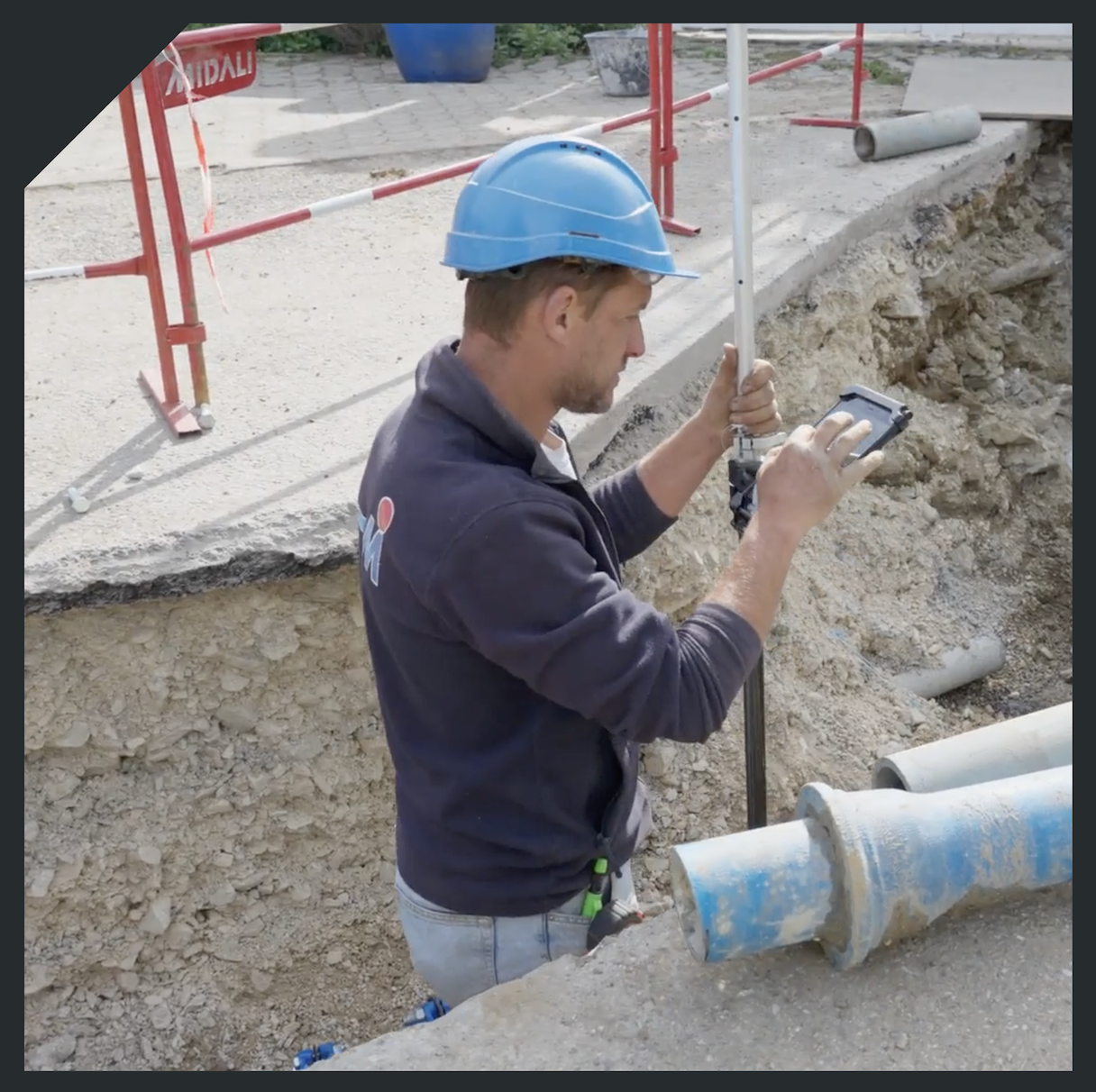
Working from a tablet in the field, site managers can now carry out setting-out and as-built surveying tasks on their own utility projects, recording survey points, photographs, and sketches directly within the platform as work progresses.
For the technical office, this has substantially simplified data processing. Information arrives in a consistent and usable format rather than as a collection of informal field notes requiring interpretation and reconstruction. Documentation becomes part of the construction workflow rather than an exercise conducted retrospectively using partial information.
The effect on internal communication was immediate. Survey points, photographs, and field sketches are available to the technical office in real time, enabling corrections and decisions to be made remotely as issues arise, without requiring a site visit.
Drawing management changed significantly as well. Updated project plans are uploaded directly to Infrakit and become immediately accessible on tablets in the field, removing the need for office staff to distribute the latest drawings in person.
The deeper change lies in how the office and the site now work together to solve problems. Both parties operate from the same live graphical document — not different versions of a printed plan and not a verbal description over the phone, but the same source of information in real time.
“I can be in the office while the site manager is out on site, and we’re looking at exactly the same thing — because he no longer has a paper drawing. He has a live graphical document that he can use to share information with me.”
That shared reference fundamentally changes the conversation. Problems can be identified and resolved more quickly, and context is no longer lost between what is visible on a screen in the office and what is marked on a drawing somewhere on site.
Results: Visibility Without the Site Visit
The most direct illustration of what has changed in Midali Frères’ daily operations is deceptively simple: the ability to have a complete record of what happened on a construction site today without having been there.
“A utility connection was made today, and I already have the photographs and all the documentation. I know everything that happened on site today — without having set foot there.”
That kind of immediacy — documented, traceable, and accessible as it happens — was not achievable under the previous workflow. Today, it has become standard practice.
For an office team managing multiple sites simultaneously, the cumulative impact on workload and confidence in project data is significant.
The platform has also changed how project information is structured and stored across Midali Frères’ portfolio. All project-related documents — site-specific health and safety plans, technical specifications, contract documents, and quotations — are stored within the same project folder in Infrakit, eliminating the fragmentation that previously made end-of-project compilation so labour-intensive.
Completed projects are archived and remain retrievable on demand. If questions arise after handover regarding utility locations, specifications, or installation details, the information remains available — independent of local storage, individual hard drives, or the recollections of staff who may have since moved on.
The overall effect across the business is tangible: less administrative effort, greater accuracy in as-built records, and a more controlled workflow from installation through to client handover.
Looking Ahead: Scaling What Works
Midali Frères’ experience has led to a clear next step: extending Infrakit to a larger number of site managers in the field, making connected field documentation standard practice across the organisation rather than a capability limited to a few individuals.
This direction reflects how Midali Frères now views documentation as a discipline: not as a specialist task reserved for survey professionals, but as a core operational competency for anyone managing a construction site.
When site managers can independently carry out setting-out and as-built capture, and that information flows directly back to the technical office, the survey bottleneck that once constrained project delivery is effectively removed from the process.
For infrastructure contractors managing dense portfolios of utility construction projects, the lesson is transferable. The technology required to enable this workflow already exists. When implemented effectively, what changes is not merely the toolset. It is the reliability of the data — and the time savings and confidence that come with it.