

Trigo uses Infrakit as a shared, map-based workspace for survey collaboration, machine control and site visibility—and together with Topcon, is building a smoother office-to-machine workflow via Topcon Sitelink3D, so constructible design data stays current all the way to the machines. We spoke with Richard Åberg, Survey Engineer at Trigo Mätteknik AB, and Johan Mattsson, Business Area Manager at Trigo, to understand how this combined setup supports large civil projects.
Customer
Trigo Mätteknik AB is a Swedish surveying specialist supporting major civil and infrastructure projects. Founded as a dedicated surveying unit in 2018/2019, Trigo has grown to a team of ~16 people, with a clear focus: keep complex sites moving by ensuring teams work from the same, current ground truth.
Partners
Infrakit provides the shared workspace that connects office and field teams through live map context, controlled access, and time-based site documentation. Topcon provides the machine control ecosystem—using Topcon Sitelink3D to distribute construction-ready files to connected machines and help keep design elements (such as surfaces) up to date.
The challenge: too many systems, too many handoffs, too little time
On large infrastructure sites, Trigo sits at the center of information flow. But before adopting Infrakit, Trigo described a reality many surveying teams recognize: multiple tools, multiple stakeholders, and constant requests for “the latest.” Because the surveying lead is the central point of knowledge, they’re frequently relied on for sharing updates, answering common questions, and keeping everyone aligned on the latest information.
Trigo’s team put it simply: without a shared platform, the survey lead becomes the human hub everyone depends on for updates—creating an avoidable bottleneck for the whole project.
At the same time, project scale keeps rising. In the demo, Trigo referenced environments with dozens of machines working in parallel—where file-based handoffs (USB sticks, scattered cloud folders, one-off emails) are not just inefficient, but risky.
“[Infrakit] is an enormous time saver. We’ve been having up to almost 90 machines in one site, using USB, we would have to be a much bigger organisation at site in order to handle that”, Johan Mattsson, Business Area Manager at Salboheds.
Robin Jansson, Customer Success Manager at Infrakit adds: “The dedicated cloud for each machine system is simply too much administrative work – it is way easier to use one platform to manage all machine control systems”.
The solution: a shared platform for site collaboration—and a foundation for office-to-machine flow
Trigo consolidated essential project information into a single shared environment with Infrakit, so stakeholders can self-serve what they need without waiting on one person. In parallel, Trigo is strengthening the office-to-machine chain with Topcon—so construction-ready files can be distributed through Sitelink3D to the machines working on the job, with less version confusion.
What changed in practice
1) Self-serve access instead of constant interruptions
Instead of routing every question through the surveying team, site stakeholders can find the latest information directly in Infrakit—reducing noise, speeding up decisions, and freeing surveyors to focus on high-value work.
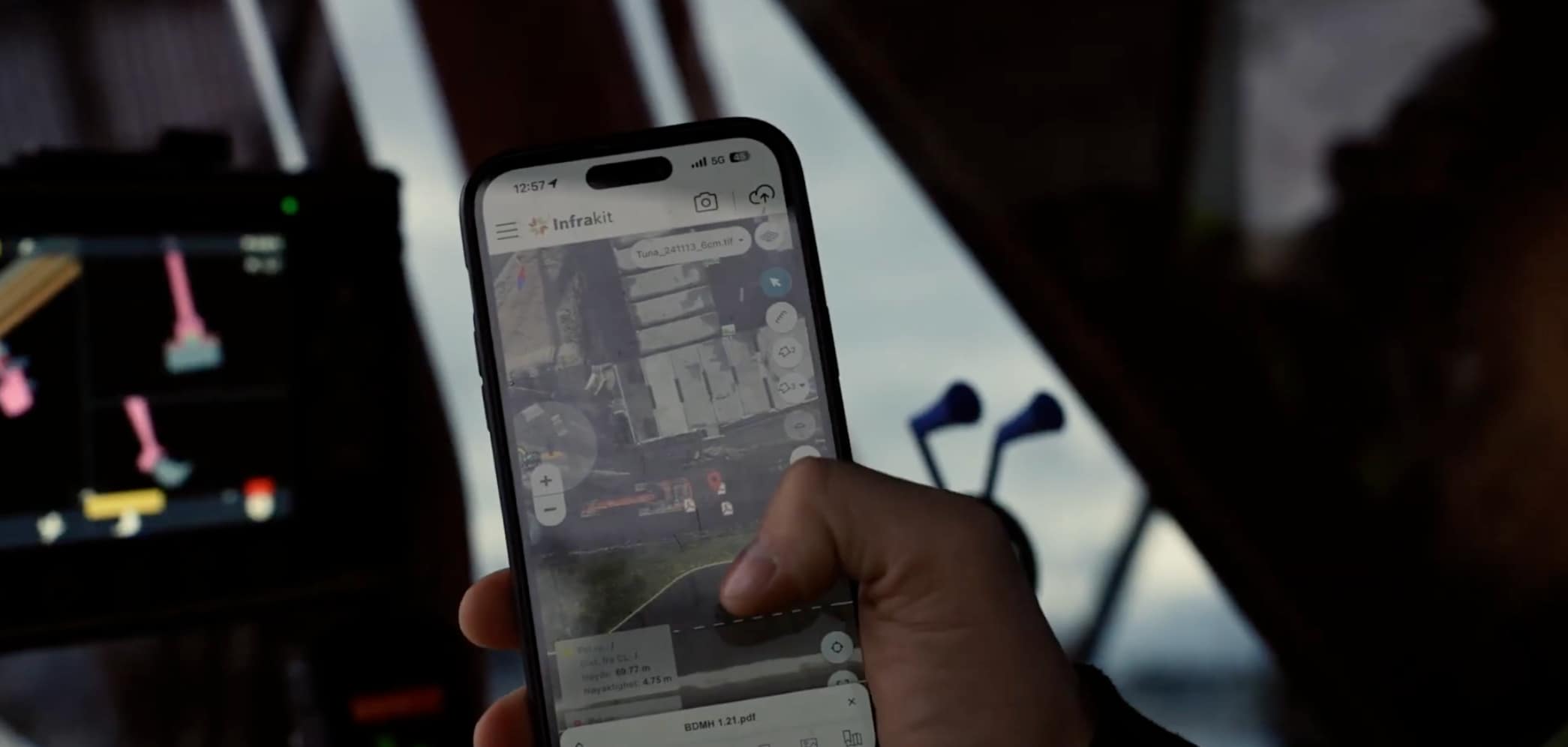
2) Mobile access that works for the broader site team
Trigo emphasized that adoption matters most when non-surveyors can use the tool confidently. Infrakit’s mobile access makes it practical for crews to check key lines, slopes, and context on site—without needing specialist software.
3) Map-based clarity across stakeholders
A shared visual view helps align everyone on the same “source of truth”—especially on infrastructure projects where “where” matters as much as “what.” This reduces ambiguity and limits rework caused by misalignment or outdated information.
The biggest value: traceability, proof, and fewer disputes
Beyond speed, Trigo highlighted the power of traceability. In fast-moving projects, questions inevitably come up later: What was done when? What did it look like then? Which version was available at that point? A clear historical record reduces friction and helps teams resolve misunderstandings quickly and objectively.
Trigo pointed to the ability to revisit earlier stages of the build through time-stamped site documentation—making it easier to align stakeholders and support discussions with evidence when needed.
“And, of course, the aftercare – you will have all the images collected, GEO-referenced. The traceability throughout the pictures is amazing, because you can go back from the start of the project and see, okay, this day, this part of the project was built <…> just click your way back, you will see what happened last week, and the week before. <…> It’s beautiful in that sense”, Johan Mattsson, Business Area Manager at Salboheds.
Keeping reality current: routine drone capture as part of the workflow
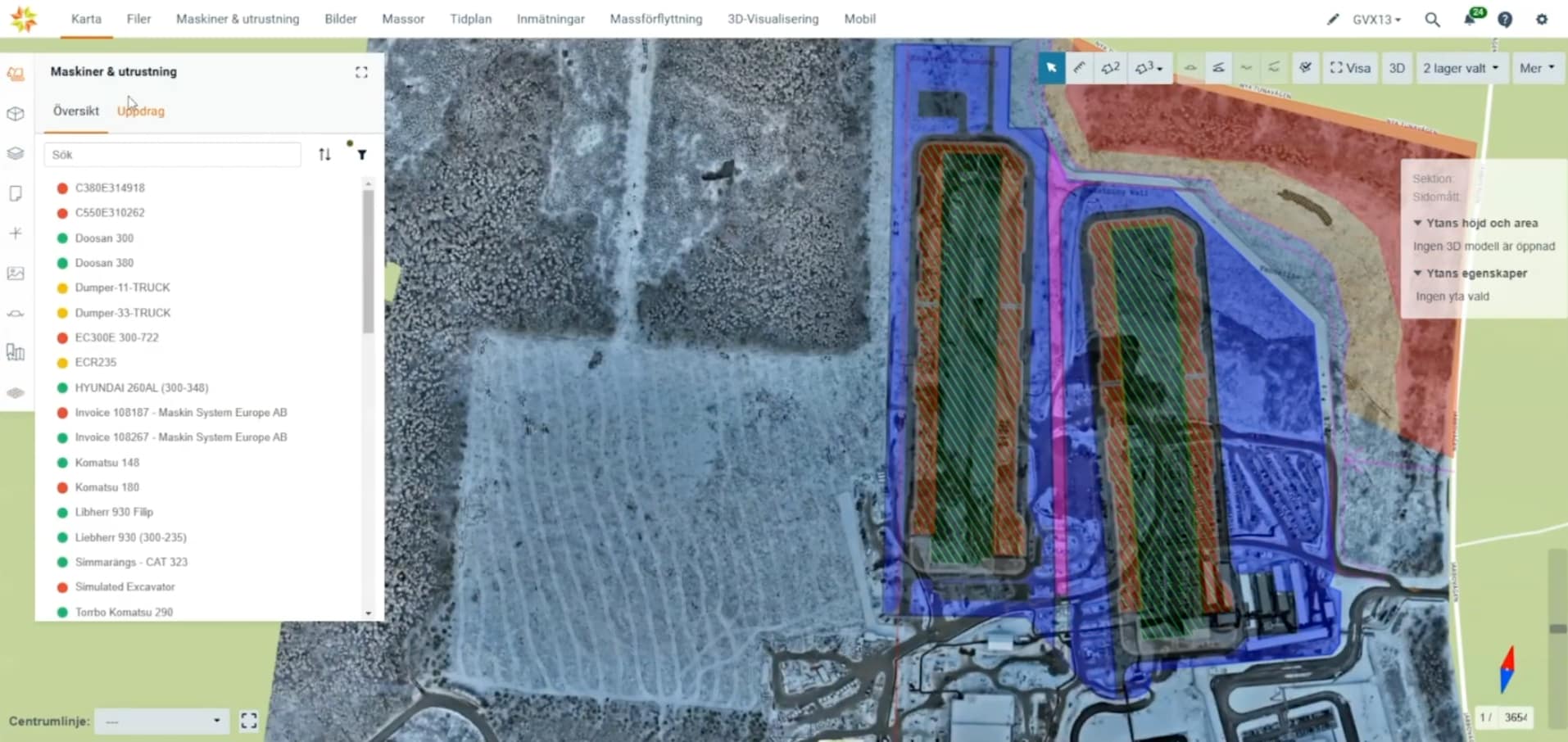
Trigo supplements survey work with regular drone flights—capturing reality data on an ongoing cadence (e.g., weekly). This helps teams validate progress, compare planned vs. actual, and make more confident decisions based on recent site context.
“We fly these sites with a drone once a week. In Infrakit, you will always have the latest images and all the data necessary for mass calculations. <…> for mass calculations”, Johan Mattsson, Business Area Manager at Salboheds.
Topcon: office-to-machine distribution that keeps execution aligned
As Trigo scales digital workflows, distributing construction-ready machine files becomes increasingly important. With Infrakit managing design data centrally and Topcon Sitelink3D distributing it to Topcon-enabled machines connected to the job, teams can work from the same current design elements—such as surfaces—without relying on manual, one-to-one handoffs.
The combined Infrakit + Sitelink3D workflow is designed to minimize versioning errors and reduce coordination bottlenecks: updates are managed in one place, then made available to the machine ecosystem so crews can keep moving with fewer interruptions and fewer “which version is correct?” moments.
Why it worked: simplify access, then let the site pull the value
Trigo described adoption as a practical, site-led process: win over a few respected people, make the workflow easy on mobile, and the rest follows. Once usage reaches a critical mass, the platform becomes the default place to check what’s current—reducing dependency on manual coordination and helping the project operate faster, with fewer interruptions.
Results
- Faster sharing of survey outputs and critical site files through one shared platform
- Less time spent on manual distribution and repeated stakeholder questions
- Clearer alignment across stakeholders through a shared, map-based view
- Stronger traceability via time-based documentation to support discussions and reduce disputes
- Constructible design data managed centrally and distributed to connected machines via Topcon Sitelink3D—minimizing versioning errors
- Communication bottlenecks reduced through smart, accessible site workflows that let teams self-serve current information